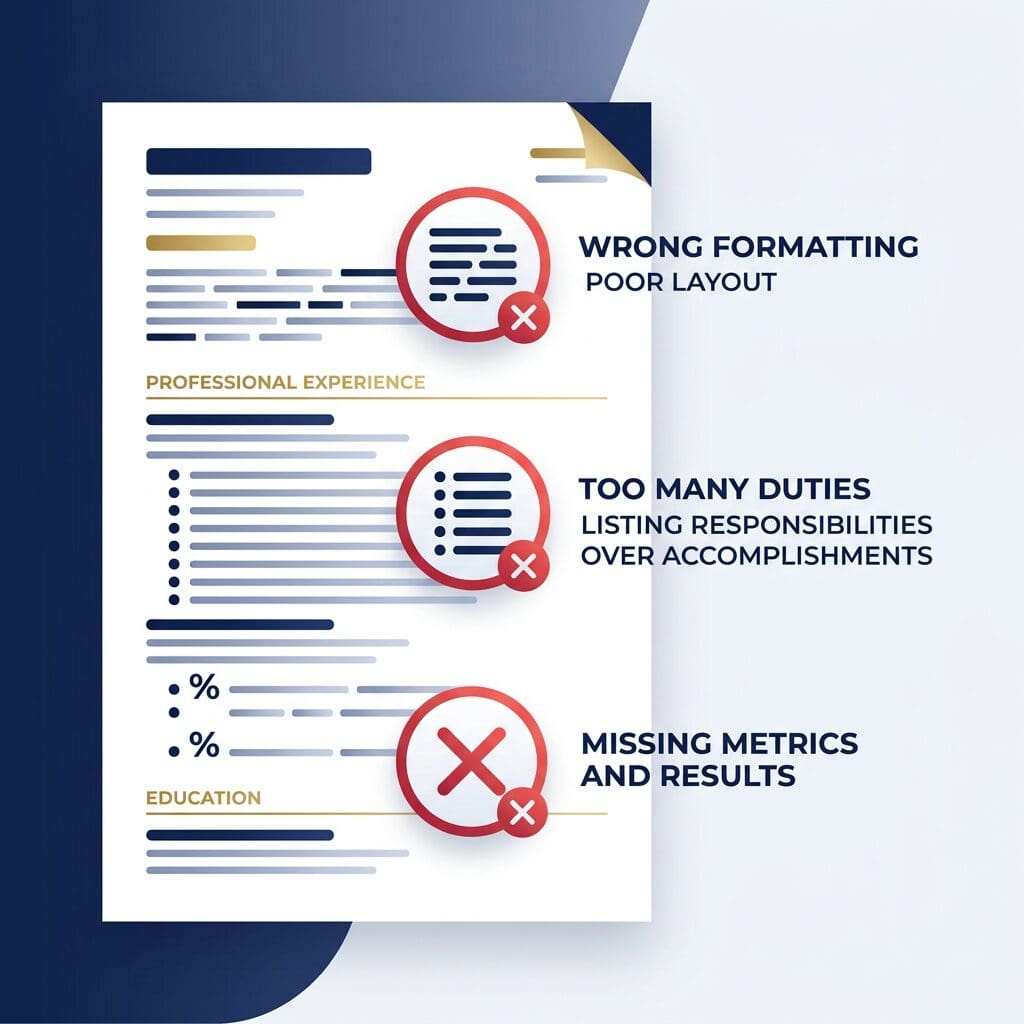
Common Resume Mistakes Executives Make and How To Fix Them
The biggest issue with executive resumes isn’t formatting—it’s positioning. Most senior leaders undersell themselves in ways that wouldn’t pass in a boardroom conversation. Here are the core problems that show up again and again—and how to fix them.
1. They read like job histories instead of leadership stories
Executives often include long lists of responsibilities, as if they’re still being evaluated on execution.
Problem:
“Responsible for overseeing operations and managing teams…”
Fix:
Shift to strategic narrative + outcomes
- “Led enterprise-wide operations across 3 regions, delivering 28% cost reduction and scaling revenue to $400M.”
This is something sources like Harvard Business Review consistently emphasize: your resume should reflect decisions, impact, and direction, not tasks.
2. Lack of a clear leadership brand
Many executive resumes start with a vague summary that could apply to anyone.
Problem:
“Experienced senior leader with a track record of success…”
Fix:
Define a sharp positioning statement at the top:
- Industry + function + scale + specialty
- Example: “Private equity-backed SaaS CEO specializing in turnaround growth and exit strategy”
This is your value proposition, not an introduction.
3. Weak or missing metrics (especially at scale)
Executives sometimes assume their title speaks for itself. It doesn’t.
Problem:
- No numbers
- Or small, tactical metrics (“improved efficiency by 5%”)
Fix:
Show scope and magnitude:
- Revenue/P&L size
- Team size
- Market expansion
- Strategic outcomes
Example:
- “Oversaw $750M P&L, leading 1,200 employees across 4 continents; drove 35% EBITDA growth in 24 months”
Measurable impact is non-negotiable
4. Too much detail, not enough curation
Senior professionals often try to include everything they’ve done.
Problem:
Dense, 3–5 page resumes filled with mid-career details
Fix:
Be selective:
- Focus on the last 10–15 years
- Highlight transformational wins, not steady-state roles
- Older roles = compressed or removed
5. No evidence of strategic leadership
Some resumes show execution, but not influence or decision-making.
Problem:
- Operational language
- No mention of strategy, stakeholders, or board interaction
Fix:
Make strategy visible:
- “Advised board on M&A strategy…”
- “Led post-merger integration…”
- “Defined 5-year growth roadmap…”
This is where many candidates fall short compared to peers.
6. Generic tone (reads like everyone else)
At the executive level, sameness is a liability.
Problem:
Buzzwords: “results-driven,” “dynamic leader,” “team player”
Fix:
Use specific, differentiated language:
- Industry-specific challenges
- Unique achievements
- Signature strengths
Your resume should sound like you, not a template.
7. Ignoring how executive hiring actually works
Many resumes are written for ATS systems or recruiters—but senior hiring is often network-driven and board-influenced.
Problem:
Over-optimized keywords, underdeveloped narrative
Fix:
Balance both:
- Yes, include relevant keywords
- But prioritize clarity, story, and credibility
Structure beats keyword stuffing at this level.
Bottom line
An executive resume should answer three questions immediately:
- What kind of leader are you?
- What scale have you operated at?
- What measurable impact have you delivered?
Contact us for your free resume critique (866) 695-9318 | www.ANewResume.com